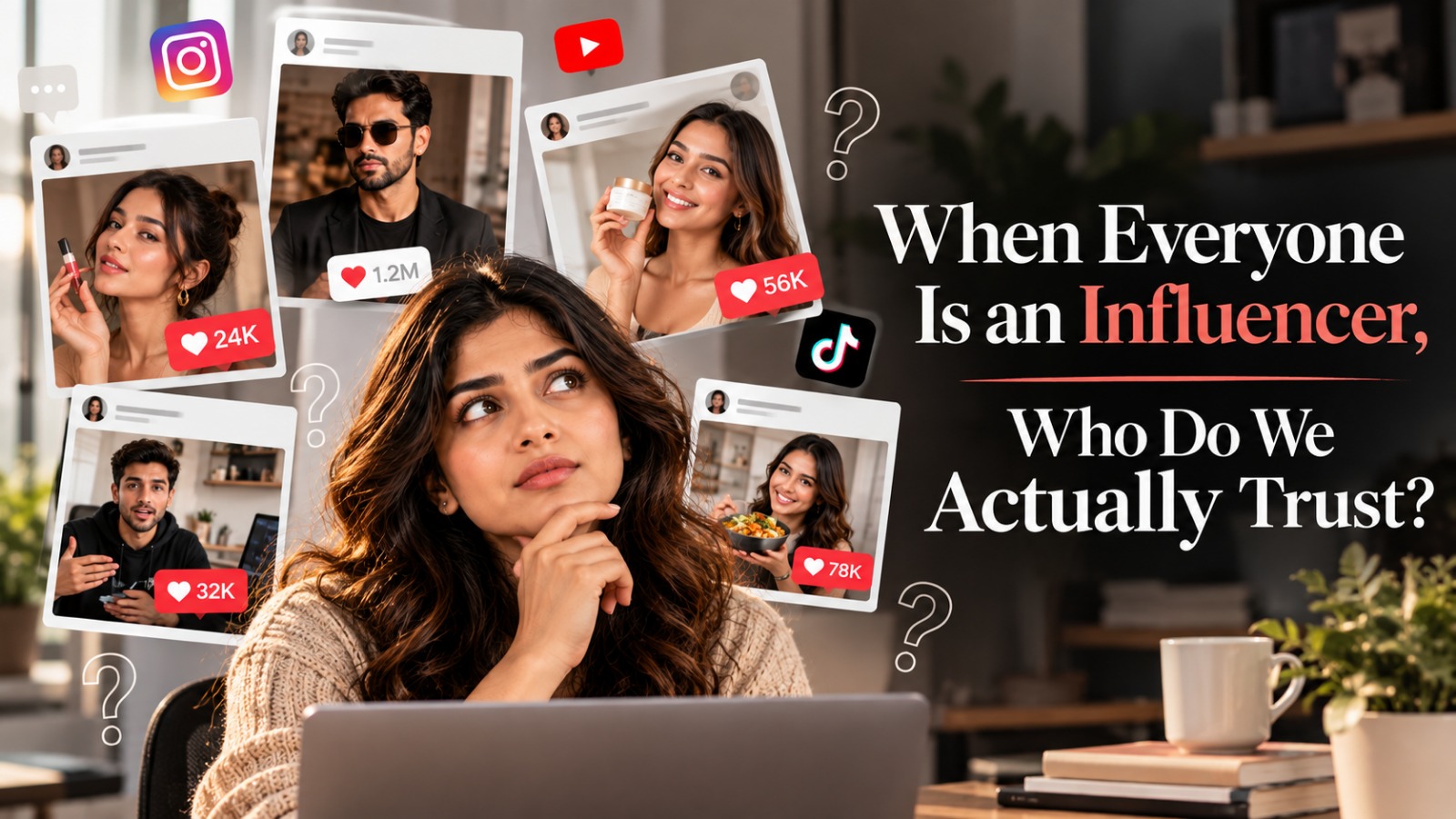
Remember when seeing your favourite actor holding a shampoo bottle was enough to make you think, “maybe I should try it too?” That was influencer marketing before we even called it influencer marketing. Celebrities had the fame, brands had the products, and audiences simply watched. Then social media changed everything. Suddenly, influence wasn't reserved for actors, athletes or celebrities. A girl reviewing lipsticks from her bedroom could influence thousands of purchases. A food creator could turn a small café into a weekend hotspot, and a college student could make a ₹500 product go viral. And now? Almost everyone is an influencer.
So, in a world overflowing with recommendations, who do we actually trust?
From Famous Faces to Familiar Faces
The biggest shift in influencer marketing isn't really about followers. It's about familiarity.
We may admire celebrities, but creators often feel like people we know. They show us the bad hair days, the failed recipes, the “don't buy this” reviews and the products they genuinely keep using. That imperfection makes them feel human and humans trust people they can relate to.
That's why a creator with 20,000 followers in a specific niche can sometimes feel more convincing than a celebrity with 20 million. The audience isn't necessarily asking, How famous are you? " They're asking, “Do you understand me?”
The Micro-Influencer Effect
This is where micro-influencers have changed the game. A smaller audience doesn't necessarily mean smaller influence. Imagine two creators recommending a new skincare product. One has 2 million followers and talks about everything from fashion to travel to food. The other has 30,000 followers and has spent the last three years talking almost exclusively about skincare.
Who feels more relevant?
The answer isn't always obvious and that's exactly the point.
Reach gets attention. Relevance gets action.
For brands, the real opportunity isn't always finding the biggest creator. It's finding the creator whose audience actually cares.
But Then Came the Trust Problem
Here's the catch: the more influencer marketing we see, the better we become at recognising it. “Obsessed with this product!”, “Guys, you NEED this!”Use my code! When every post starts sounding like an advertisement, people start tuning out. And that's where influencer marketing faces its biggest contradiction: the moment influence starts feeling manufactured, it starts losing its influence. Being paid doesn't automatically make a recommendation fake, but pretending a paid partnership is just a spontaneous discovery can make audiences question everything else the creator says. Today, people don't necessarily expect influencers to be unpaid; they simply expect them to be honest.
Your Friend Might Be More Influential Than a Celebrity
Here's something brands often overlook: not all influence happens on Instagram. It happens when your friend tells you which café to visit, when your colleague recommends a laptop, when someone on Reddit explains why they returned a product, or when a customer posts an unfiltered review. Even a simple WhatsApp message saying, “Don't buy this. I tried it,” can influence a decision. None of these people may call themselves influencers, but they influence us every day. And that tells us something important: influence isn't a job title. It's a relationship.
So, What Makes Someone Trustworthy?
Maybe it's not a follower count, the blue tick, or even how polished the content looks. It could be something much simpler: consistency, expertise, honesty and relevance. Most importantly, it's the feeling that there is a real person behind the recommendation. A creator who says, This product isn't for everyone, can sometimes be more convincing than one who says,This is perfect Because honesty gives people something advertisements rarely can: a reason to believe.
The Future Isn't About More Influencers. It's About Better Influence.
The influencer marketing landscape is changing, but perhaps the biggest change is happening in what audiences expect. We have moved past the stage where simply putting a creator and a product in the same frame was enough. Today, people want a reason to care. They want context, personality and, most importantly, something that feels real.
This is where the next phase of influencer marketing gets interesting. The future isn't necessarily going to belong to the creator with the largest following. It may belong to the creator who knows their audience so well that even a simple recommendation feels personal. A creator who understands what their community likes, questions, jokes about and cares about can have an influence that cannot be measured by followers alone.
Because ultimately, people don't follow numbers. They follow people. A creator can have a million followers and still feel distant. Another can have twenty thousand and feel like the friend whose opinion you always ask before buying something. The difference is not necessarily reach. It is a relationship.
The New Currency Is Context
For a long time, influencer marketing was largely about reach. Brands wanted their products in front of as many eyes as possible, but reach without context can be forgettable. Imagine a creator casually mentioning a pair of shoes in a video about their first day at a new job. The shoes are not the entire story; they are simply part of it. You see how they fit into a real moment in someone's life, making the recommendation feel more natural and relatable. That is far more powerful than seeing a product floating against a perfect background with a discount code underneath it. The future of creator marketing will increasingly be about placing products inside stories rather than simply placing products inside posts. People remember stories they remember the creator who packed the product for a trip, used it during a bad day, discovered it by accident, or genuinely kept using it months after the collaboration ended. The product becomes part of the story, instead of becoming the story.
From Campaigns to Communities
Another major shift is that brands are beginning to realise that a creator's greatest value may not be the post they publish, but the community they have built around them. A good creator doesn't simply collect followers; they create a space where people with similar interests gather, share opinions, ask questions and influence each other. That means the relationship between a brand and a creator doesn't have to end when the campaign does. The smarter question is: Can the brand become part of that community without disrupting it? There is a big difference between entering a community and interrupting one. Nobody wants their favourite creator's page to suddenly feel like a billboard. But when a brand genuinely understands the community, adds something useful and gives people a reason to participate, the relationship can become far more meaningful. Perhaps the strongest influencer campaigns of the future won't feel like advertising campaigns at all; they will feel like community moments.
The Creator Is Becoming a Creative Partner
There is another important change taking place behind the scenes: brands are slowly learning that creators don't just bring audiences; they bring ideas. A creator knows what their audience skips, what they comment on, what makes them laugh, what questions they repeatedly ask and what kind of language feels natural to them. That understanding is incredibly valuable. Instead of handing creators a rigid script and asking them to repeat five brand messages, brands can give them something much more powerful: creative freedom with strategic direction. The brand knows what it wants to communicate, while the creator knows how their audience wants to hear it. When those two things come together, the content feels less like an advertisement and more like something that naturally belongs on the platform. And perhaps that is one of the biggest lessons for brands: don't just buy the creator's audience. Learn from the creator's understanding of that audience.
When Everyone Can Create, Originality Becomes Scarce
There is another problem waiting around the corner. The creator economy is growing rapidly, which means there is more content than ever before, more Reels, more reviews, more unboxings, more “Get Ready With Me” videos and more product recommendations. When everyone has access to the same trends, sounds and formats, everything can start to look strangely similar. That is when originality becomes valuable again. The next big creator may not necessarily be the person who follows every trend perfectly, but the one who makes you stop and think, “I've never seen someone do it like that before.” The same applies to brands. If every brand is trying to sound relatable, being genuinely distinctive becomes harder. If everyone is trying to be funny, humour alone is no longer enough. And if everyone is trying to go viral, simply going viral doesn't make a brand memorable. When everyone is trying to stand
The Rise of the Honest Creator
Perhaps the most interesting creator of the future will be the one who doesn't pretend to know everything the creator who says, “I haven't tried this yet,” admits, “This is good, but I wouldn't spend my money on it,” changes their opinion after using something for three months, or simply tells their audience when a product isn't meant for them. That kind of honesty may seem risky from a brand's perspective, but it can actually make the relationship feel more genuine. Audiences don't expect creators to be perfect; they expect them to be believable. And believable people are allowed to change their minds.
The Audience Is Becoming Part of the Campaign
Perhaps the most exciting development is that audiences themselves are no longer passive. They remix content, create memes, respond with their own experiences, make parody videos, post reviews, share products with friends and sometimes take a campaign somewhere the brand never expected it to go. A creator may start the conversation, but the audience can take it somewhere entirely different. This means brands are increasingly creating something that doesn't have a fixed ending. The post goes live, but the campaign continues to evolve through comments, shares, remixes, conversations and user-generated content. In that sense, the audience isn't just consuming the campaign; they're helping write it. And that is a very different way of thinking about marketing.
So, What Should Brands Be Looking For?
Perhaps the next generation of influencer marketing won't begin with, “How many followers does this creator have?” Instead, it will ask: Do people trust them? Is their content relevant, believable and genuinely engaging? Because a creator's real value isn't just reach, it's the relationship they have with their audience. A good campaign can generate impressions. A great one can start conversations. The most meaningful ones can actually influence what people think, feel and do. That means moving away from scripted endorsements and follower counts, and towards authentic stories, communities and real impact. Sometimes influence is a million-view Reel; sometimes it's a comment, a shared screenshot or a friend saying, “I bought this because they recommended it.”In a world where anyone can become an influencer, being seen is no longer the difficult part. Being believed is.