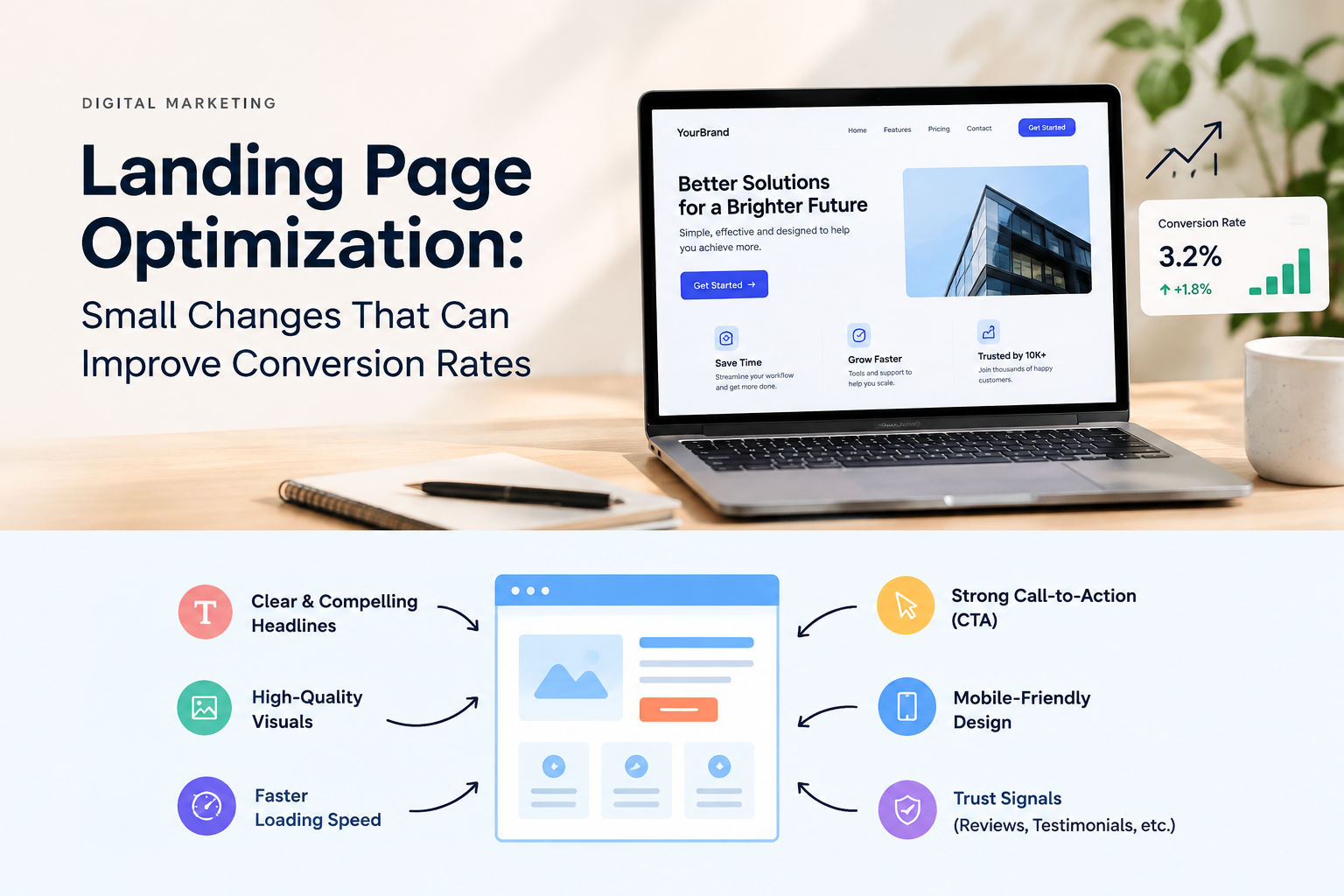
Landing Page Optimization: Small Changes That Can Improve Conversion Rates
Getting visitors to your website is important, but turning those visitors into customers is what helps your business grow. If people visit your website but leave without submitting an enquiry, booking a consultation, or making a purchase, your landing page may need improvement.
Landing page optimization helps businesses improve webpage content, design, speed, and user experience to encourage visitors to take action. Whether you generate traffic through SEO, Google Ads, social media, or email marketing, an effective landing page can help you get more value from your marketing efforts.
In this guide, we will explore practical landing page optimization techniques that can improve user experience and support better conversion rates.
What Is Landing Page Optimization?
Landing page optimization is the process of improving a webpage to increase the percentage of visitors who complete a specific action, such as filling out a form, purchasing a product, or booking a consultation.
For example, if 1,000 visitors land on your page and 30 submit an enquiry form, your conversion rate is 3%.
The goal is to make your offer clear, build trust, and remove obstacles that prevent visitors from taking the next step.
Why Is Landing Page Optimization Important?
A website may attract traffic without generating enough enquiries or sales. Optimizing your landing page helps you make better use of existing visitors.
Key benefits include:
Higher conversion potential: Make it easier for visitors to take action.
Better marketing performance: Connect your ads and SEO content with relevant landing pages.
Improved user experience: Help visitors find information quickly.
Better lead quality: Clearly communicate your services and target audience.
More informed decisions: Use analytics to identify areas that need improvement.
7 Landing Page Optimization Techniques to Improve Conversions
1. Write a Clear and Compelling Headline
Your headline is one of the first things visitors notice. It should explain what you offer and why it matters to your audience.
For example:
Weak headline: Welcome to Our Website
Improved headline: Generate More Qualified Leads With Digital Marketing
A clear headline helps visitors understand your value quickly. Focus on the problem you solve and the benefit your audience can expect.
2. Use a Strong Call-to-Action (CTA)
A call-to-action tells visitors what to do next. If your CTA is unclear or difficult to find, visitors may leave without converting.
Use simple, action-oriented phrases such as:
Book a Free Consultation
Request a Quote
Get Started Today
Contact Our Team
Keep your primary CTA visible and relevant to your offer. Avoid adding too many competing buttons that distract visitors from the main objective.
3. Improve Website Loading Speed
Slow-loading pages can frustrate visitors and create a poor user experience. Optimize your images, reduce unnecessary scripts, use suitable hosting, and check your website with Google PageSpeed Insights.
Pay attention to Core Web Vitals, including loading performance, responsiveness, and visual stability.
A faster website can make it easier for visitors to interact with your page, although speed improvements alone do not guarantee higher conversions.
4. Make Your Landing Page Mobile-Friendly
Your landing page should work smoothly across smartphones, tablets, and desktops.
To improve mobile usability:
Use readable text and responsive layouts.
Make buttons easy to tap.
Keep forms short and simple.
Ensure images fit smaller screens.
Test the complete enquiry or checkout process on mobile.
A mobile-friendly experience helps visitors navigate your website without unnecessary effort.
5. Simplify Contact Forms
Long forms can discourage potential customers from submitting enquiries. Ask only for the information you need at the initial stage.
For a service-based business, a simple form might request a name, email address, company name, and required service.
Use clear field labels, helpful error messages, and a straightforward submission process. Test different form layouts to understand which works best for your audience.
6. Build Trust With Genuine Reviews and Testimonials
Visitors are more likely to consider your offer when they can evaluate your credibility.
You can build trust by including genuine customer testimonials, relevant case studies, verified reviews, clear contact information, and transparent service details.
For example, a marketing agency can explain a client's business challenge, the strategy used, and the results achieved. Always ensure that any testimonials and performance figures are accurate.
7. Test and Measure Your Landing Page Performance
Landing page optimization should be based on data rather than assumptions.
Use tools such as Google Analytics 4 to monitor conversions and visitor behaviour, Google Search Console to review organic search performance, and Google PageSpeed Insights to assess website performance.
You can test different headlines, CTA wording, form lengths, and page layouts to identify potential improvements.
Track relevant metrics, including conversion rate, form submissions, CTA clicks, cost per lead, and lead quality. Focus on meaningful business results rather than website traffic alone.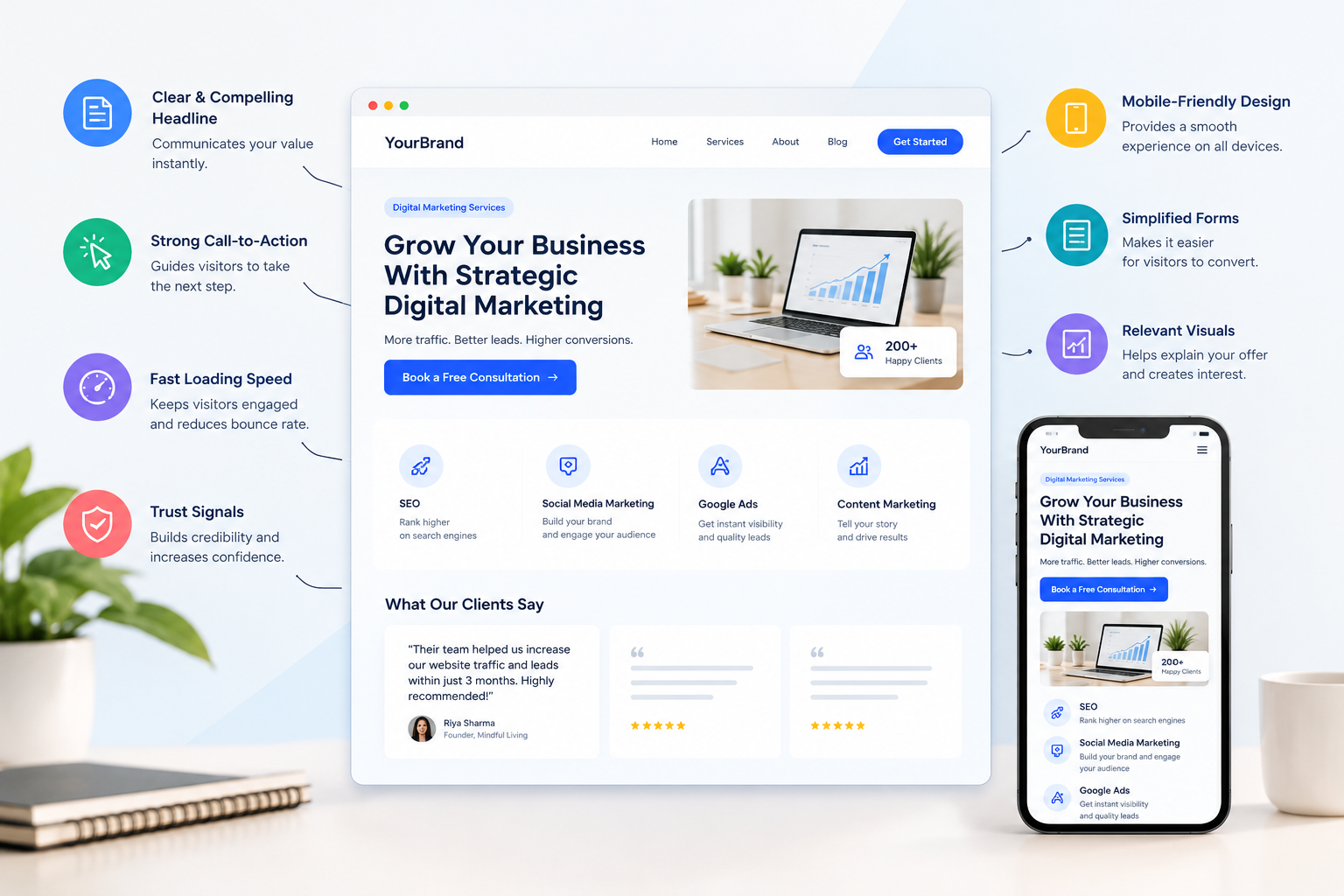
How to Calculate Your Landing Page Conversion Rate
You can calculate your conversion rate using this formula:
Conversion Rate = (Conversions ÷ Total Visitors) × 100
For example, if your landing page receives 2,000 visitors and generates 60 enquiries, your conversion rate is 3%.
There is no single ideal conversion rate for every business. Performance depends on factors such as industry, traffic source, audience, and offer. Compare results with your own baseline and monitor changes over time.
Common Landing Page Mistakes to Avoid
Avoid these common mistakes when optimizing your landing pages:
Using vague headlines that do not explain the offer.
Adding too many form fields or unnecessary steps.
Ignoring mobile usability and page speed.
Using misleading claims or unverified testimonials.
Including too many competing calls to action.
Failing to track conversions and lead quality.
Fixing these issues can help create a clearer and more effective experience for potential customers.
Conclusion
Landing page optimization is an important part of a successful digital marketing strategy. Improvements to headlines, CTAs, page speed, mobile usability, forms, and trust signals can help visitors understand your offer and take the next step.
The key is to understand your audience, identify problems in the user journey, and measure the impact of your changes. By continuously improving your landing pages, you can make better use of your website traffic and support your business growth.
Looking to improve your website performance? A well-planned digital marketing strategy can help attract relevant visitors and turn more of them into potential customers. Explore SEO, website optimization, and other digital marketing solutions that align with your business goals.
Frequently Asked Questions (FAQs)
1. What is landing page optimization?
Landing page optimization is the process of improving a webpage's content, design, speed, and usability to encourage more visitors to complete a desired action.
2. How can I improve my landing page conversion rate?
Improve your headline, clarify your offer, use a strong CTA, simplify forms, optimize page speed, and ensure your page works well on mobile devices.
3. Does landing page optimization help SEO?
It can support SEO by improving content relevance, usability, and page performance. However, conversion improvements do not automatically guarantee higher Google rankings.
4. Which tools can help with landing page optimization?
Google Analytics 4, Google Search Console, and Google PageSpeed Insights can help you measure conversions, review organic search performance, and identify technical performance issues.
5. How often should I optimize my landing page?
Review performance regularly and whenever you make significant campaign or website changes. Use analytics and visitor feedback to prioritize improvements.