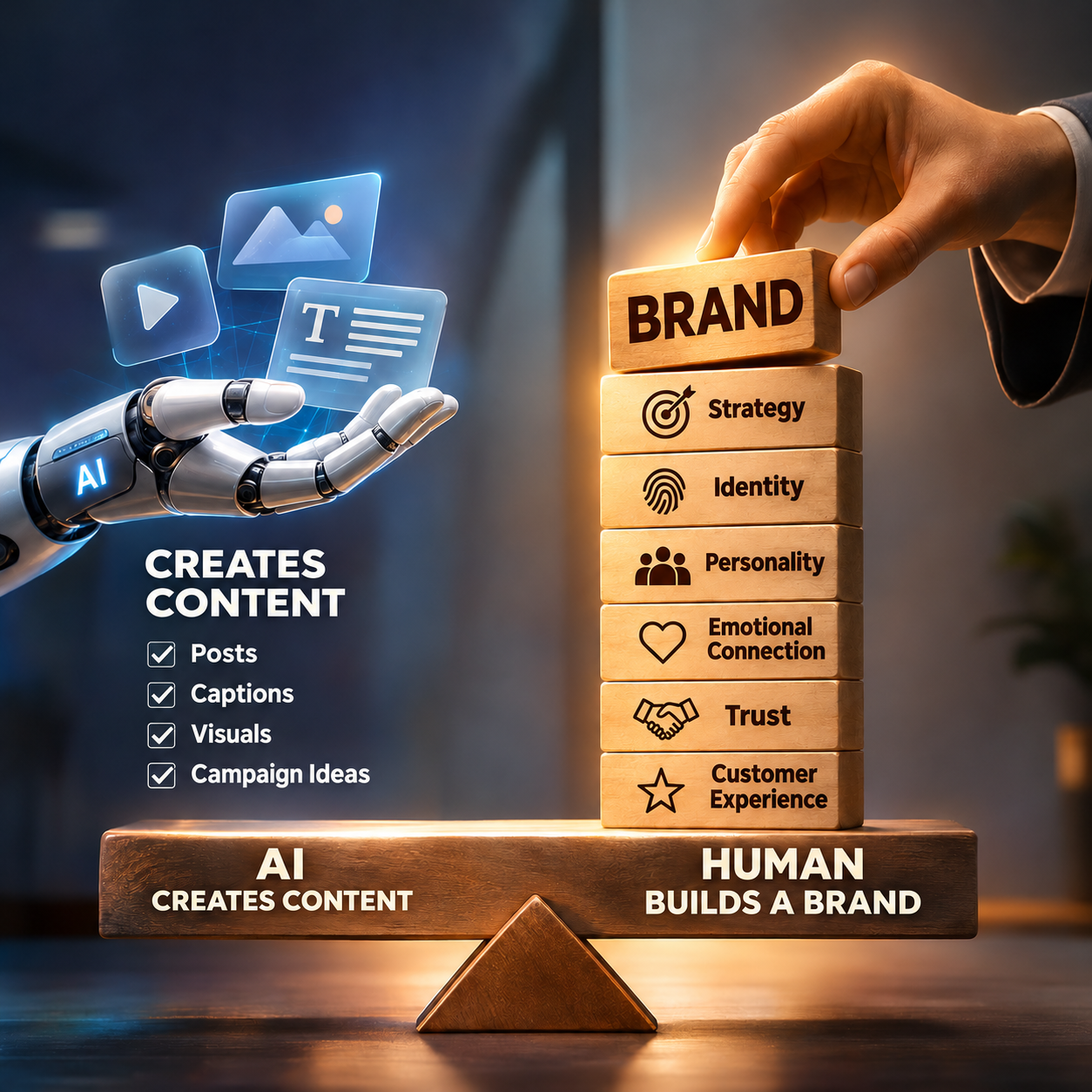
Artificial Intelligence has transformed the way businesses approach content creation. From generating social media captions and designing advertisements to writing blogs and developing marketing campaigns, AI-powered tools have made content production faster, more accessible and increasingly efficient. However, as businesses become more dependent on AI-generated content, an important question emerges: Can artificial intelligence actually build a brand, or can it only create the content that represents one? While AI can generate ideas, produce visuals and analyse consumer behaviour, building a successful brand involves much more than consistently publishing content. It requires a clear identity, a distinctive personality, emotional connections, strategic positioning and the ability to create meaningful experiences for customers. Understanding the difference between AI-generated content and strategic brand building is becoming increasingly important for businesses operating in today's competitive digital environment. Content creation and brand building are closely connected, but they serve different purposes within a marketing strategy. Content creation involves developing material such as social media posts, blogs, videos, advertisements and other forms of communication to attract and engage audiences. Brand building, on the other hand, focuses on establishing how a business is recognised, perceived and remembered by its target audience. It involves developing a consistent identity, communicating a clear purpose and creating experiences that distinguish the business from its competitors. For example, AI can generate multiple Instagram captions for a skincare brand within seconds. However, deciding whether that brand should communicate as luxurious, youthful, scientific or approachable requires a deeper understanding of its positioning and audience. The distinction can be understood through the following comparison: Content Creation: Focuses on producing marketing material that communicates information and engages audiences. Brand Building: Focuses on creating a consistent identity, establishing trust and developing long-term customer relationships. Content Creation: Can be accelerated through automation and AI-powered tools. Brand Building: Requires strategic direction, creativity, human understanding and consistency. Content helps communicate a brand, but it is the identity and experience behind that content that make a brand memorable. AI has introduced new possibilities for businesses looking to improve their marketing operations. Tasks that previously required significant time and resources can now be completed more efficiently with the support of AI-powered platforms. Some of the major ways AI is transforming content marketing include: AI tools can generate blog outlines, social media captions, email drafts, product descriptions and advertising copy within minutes. This allows marketing teams to develop content ideas more quickly, maintain publishing schedules and reduce the time spent on repetitive writing tasks. AI can analyse customer preferences, browsing patterns and engagement behaviour to help businesses develop more relevant marketing communication. For example, an e-commerce business can use AI-driven insights to recommend products based on customer interests and previous interactions. AI-powered design and image-generation tools can help marketers explore creative concepts, develop visual references and produce initial campaign ideas. These capabilities make experimentation easier and provide businesses with additional creative possibilities. AI can process large volumes of marketing data to identify patterns, understand audience behaviour and highlight opportunities for improvement. Businesses can use these insights to make more informed decisions about content formats, campaign performance and customer engagement. From automating routine communication to assisting with content planning, AI can help marketing teams manage multiple activities more efficiently. However, efficiency in content production does not automatically translate into stronger brand recognition or customer loyalty. Although AI can support several aspects of marketing, a successful brand requires qualities that extend beyond content production. There are several reasons why relying entirely on AI-generated communication may limit a brand's ability to establish a distinctive identity. Every successful brand needs a well-defined identity. Its purpose, values, personality, positioning and target audience influence how it communicates with customers. AI can help businesses explore positioning ideas and generate brand messaging. However, these outputs need strategic direction to ensure they accurately represent what the business stands for. Without a clear brand strategy, businesses may end up producing large volumes of content without establishing a recognisable identity. Consumers do not connect with brands simply because they publish attractive visuals or well-written captions. They connect with the experiences, values and emotions associated with those brands. For example, a brand communicating around sustainability must demonstrate its commitment through its products, business practices and customer experiences rather than relying only on AI-generated messaging about environmental responsibility. AI can help communicate emotions through storytelling, but genuine emotional connections are strengthened through authentic actions and consistent experiences. A brand's personality determines how it sounds, communicates and interacts with its audience. Some brands use humour and conversational language, while others adopt a professional, sophisticated or informative tone. AI can replicate different writing styles, but without clear brand guidelines, its output may become generic or inconsistent. A recognisable brand needs a distinctive voice that remains consistent across social media, websites, advertisements, emails and customer interactions. Consumers increasingly encounter AI-generated content across digital platforms. While this creates opportunities for businesses, it also makes authenticity an important factor in brand communication. Generic messaging, repetitive visuals and exaggerated claims can weaken credibility. Brands need to ensure that their communication reflects genuine product quality, customer experiences and business values. AI can assist in producing communication, but trust ultimately depends on whether a business delivers on what it promises. AI can generate ideas based on existing information, patterns and instructions. However, developing a distinctive creative direction often requires understanding cultural context, audience emotions, current conversations and unexpected opportunities. A marketing campaign that challenges conventional thinking or connects with a specific audience experience requires more than simply generating multiple creative variations. Human creativity helps businesses identify what makes an idea relevant, meaningful and different. As AI becomes increasingly integrated into marketing, the role of human creativity is becoming more strategic rather than less important. Businesses need professionals who can interpret AI-generated insights, make creative decisions and ensure that every marketing activity aligns with the brand's larger objectives. Human involvement remains particularly important in the following areas: Strategic Brand Positioning: Identifying what makes a business different, understanding its competitive environment and establishing a clear market position. Creative Direction: Developing campaign concepts, visual identities and communication styles that reflect the brand's personality. Emotional Storytelling: Understanding audience experiences and creating narratives that establish meaningful connections. Cultural Understanding: Recognising social trends, cultural sensitivities and changing consumer expectations before translating them into marketing communication. Brand Reputation Management: Making responsible decisions when addressing customer concerns, feedback and public conversations. The most effective approach is not to replace human creativity with AI, but to combine technological efficiency with human judgement and strategic thinking. AI can become a valuable part of a business's marketing strategy when its use is guided by clearly defined brand objectives. Here are some practical ways businesses can integrate AI while maintaining a distinctive brand identity: Before using AI for content production, businesses should define their brand personality, tone of voice, visual identity, messaging principles and target audience. These guidelines help ensure that AI-generated content remains aligned with the brand's communication style. AI should support the creative process rather than determine the entire direction of a campaign. Businesses can use it for brainstorming, research, content outlines and initial drafts while allowing marketing professionals to refine the final output. Publishing more content does not necessarily create stronger brand recognition. Businesses should focus on producing relevant, distinctive and valuable communication instead of relying on automated content generation simply to maintain posting frequency. AI-generated content should be reviewed for accuracy, relevance, originality and alignment with brand values before publication. This is particularly important when developing marketing campaigns, communicating product claims or addressing sensitive customer concerns. Brand building extends beyond marketing communication. Businesses must ensure that their website experience, product quality, customer service and after-sales support reflect the promises communicated through their marketing activities. AI can identify patterns in customer behaviour, but marketing teams must interpret those insights in the context of real customer expectations. Combining data-driven analysis with human understanding allows businesses to develop more meaningful marketing strategies. Several globally recognised brands demonstrate how technology, innovation and distinctive brand identities can work together. Coca-Cola has consistently built its identity around happiness, togetherness and shared experiences. The brand's marketing approach demonstrates that strong brand recognition depends on more than producing advertisements. Its distinctive visual identity, storytelling and consistent emotional associations contribute to how consumers recognise and remember it. The lesson for businesses is that technology can support campaign development, but a clear and consistent brand identity must guide the communication. Nike's brand identity extends beyond the sports products it offers. Its communication consistently focuses on performance, ambition, determination and the spirit of achievement. Its campaigns demonstrate the importance of having a distinctive brand purpose and communicating it through meaningful storytelling. AI may help generate campaign concepts, but maintaining the emotional relevance and consistency of a brand requires strategic creative direction. Netflix uses data and recommendation technology to personalise content discovery and improve the user experience. Its approach highlights how technology can help businesses understand individual preferences and make customer interactions more relevant. However, the broader brand experience also depends on content, entertainment value and the platform's overall positioning. These examples demonstrate that technology can strengthen marketing activities, but a distinctive brand identity requires a clear strategy that connects every customer interaction. Although AI offers several marketing advantages, businesses can weaken their brand identity when they rely on automation without a clear strategy. Some common mistakes include: Publishing AI-generated content without reviewing its accuracy or relevance. Using generic messaging that does not reflect the brand's personality. Prioritising content quantity over originality and quality. Relying on AI-generated visuals without maintaining visual consistency. Ignoring the importance of authentic customer experiences. Using automated communication without considering audience expectations. Adopting AI trends without evaluating whether they align with the brand's positioning. Successful AI-powered marketing requires a balance between efficiency, originality, authenticity and strategic decision-making. The effectiveness of AI in marketing should not be measured only through the volume of content produced or the speed at which campaigns are completed. Businesses must evaluate whether their marketing efforts are contributing to stronger brand recognition, meaningful engagement and long-term customer relationships. Some important metrics include: Brand Awareness: Measures how familiar target audiences are with the business and its offerings. Brand Recall: Evaluates whether consumers can remember the brand when thinking about a particular product category or requirement. Audience Engagement: Tracks interactions such as comments, shares, saves and meaningful responses to brand communication. Brand Sentiment: Helps businesses understand how customers perceive and discuss their brand across digital platforms. Customer Retention: Measures how effectively a business maintains relationships with existing customers. Conversion Rate: Evaluates how effectively marketing activities encourage audiences to take desired actions. Customer Feedback: Provides insights into customer satisfaction, expectations and the overall brand experience. By monitoring these indicators, businesses can understand whether their AI-supported marketing activities are contributing to genuine brand growth rather than simply increasing content output. Artificial Intelligence is expected to play an increasingly important role in content marketing, campaign development, audience analysis and customer communication. As these technologies become more accessible, producing content will become easier for businesses of all sizes. However, this also means that content alone may become a less distinctive competitive advantage. When multiple businesses can generate similar captions, visuals and marketing messages using the same AI tools, the real difference will come from their ideas, positioning, creativity and ability to establish meaningful customer relationships. Businesses that combine AI-powered efficiency with strong brand strategy will be better positioned to create consistent and recognisable brand experiences. The future of branding will not simply belong to businesses that use the most advanced technology. It will belong to those that understand how to use technology without losing the human qualities that make their brands distinctive. AI has significantly changed the way businesses approach content creation, making marketing activities faster, more accessible and increasingly data-driven. However, creating content and building a brand are two different processes. While AI can generate captions, visuals, blogs and campaign ideas, a successful brand requires a clear identity, strategic positioning, authentic communication and meaningful customer experiences. Businesses must therefore look beyond automation and recognise the importance of combining technological capabilities with human creativity and strategic thinking. Ultimately, AI can help a business communicate more efficiently, but what makes a brand memorable is the identity, purpose and experience behind that communication. AI can create the content. The strategy, creativity and human connection are what build the brand. At BrandFuel, we believe effective marketing goes beyond creating content. It is about developing a distinctive brand identity, communicating the right message and building meaningful connections with the right audience. With the right combination of creative thinking and strategic marketing, businesses can use emerging technologies while maintaining what makes their brands unique. Explore BrandFuel to discover how strategic marketing and creative brand communication can support your business growth. AI can assist with several aspects of brand development, including generating brand names, creating visual concepts, developing messaging and analysing audiences. However, building a successful brand requires strategic positioning, a clear identity, human creativity and consistent customer experiences. AI content creation focuses on generating marketing materials such as blogs, captions, advertisements and visuals. Brand building focuses on establishing a recognisable identity, developing trust and creating meaningful relationships with customers. AI is transforming digital marketing through automated content generation, audience analysis, personalised communication, campaign optimisation and improved marketing efficiency. It allows businesses to streamline activities and make more informed marketing decisions. AI can support brainstorming, content development and creative experimentation, but human creativity remains important for strategic thinking, emotional storytelling, cultural understanding and original campaign development. Businesses can maintain their brand identity by establishing clear brand guidelines, reviewing AI-generated content, maintaining a consistent tone of voice and ensuring that all marketing activities align with their values and positioning. Human involvement ensures that marketing communication remains authentic, relevant and emotionally meaningful. It also helps businesses make strategic decisions that reflect customer expectations and long-term brand objectives. AI-generated content can support SEO when it provides original, accurate and valuable information for readers. However, businesses should prioritise content quality, search intent, originality and usefulness rather than publishing large volumes of automatically generated material. AI will continue to influence content production, personalisation, audience insights and campaign development. However, strong brand identities, human creativity, authenticity and customer experience will remain important factors in building successful brands.AI Can Create Content, But Can It Create a Brand? Understanding the Human Side of Modern Branding
What Is the Difference Between Content Creation and Brand Building?
How Is Artificial Intelligence Transforming Content Marketing?
1. Faster Content Generation
2. Personalised Marketing Communication
3. Creative Assistance and Visual Development
4. Audience Insights and Data Analysis
5. Improved Marketing Efficiency
Why AI-Generated Content Alone Cannot Build a Strong Brand
1. Brand Identity Requires a Clear Strategic Direction
2. Emotional Connections Cannot Be Built Through Content Alone
3. Brand Personality Requires Consistency and Originality
4. Trust Is Built Through Authenticity
5. Creativity Requires More Than Predictable Outputs
The Role of Human Creativity in AI-Powered Branding
How Can Businesses Use AI Without Losing Their Brand Identity?
1. Establish Clear Brand Guidelines
2. Use AI as a Creative Assistant, Not a Replacement
3. Prioritise Originality Over Content Volume
4. Maintain Human Review and Quality Control
5. Keep Customer Experience at the Centre
6. Combine AI Insights With Human Understanding
Real-World Examples: How Established Brands Combine Technology With Brand Identity
Coca-Cola: Keeping Creativity at the Centre of Brand Communication
Nike: Building a Brand Around Purpose and Emotion
Netflix: Using Data to Improve Personalisation
Common Mistakes Businesses Should Avoid When Using AI for Branding
How Can Businesses Measure the Success of AI-Powered Branding?
The Future of Branding: AI Efficiency Meets Human Creativity
Conclusion
Building a Brand That Stands Out in an AI-Driven World?
Frequently Asked Questions
1. Can AI create a brand?
2. What is the difference between AI content creation and brand building?
3. How is AI changing digital marketing?
4. Can AI replace human creativity in marketing?
5. How can businesses use AI without losing their brand identity?
6. Why is human involvement important in AI-powered branding?
7. Is AI-generated content good for SEO?
8. What is the future of AI in brand marketing?
BRANDFUEL INSIGHTS
AI in Branding: Can AI Create a Brand?