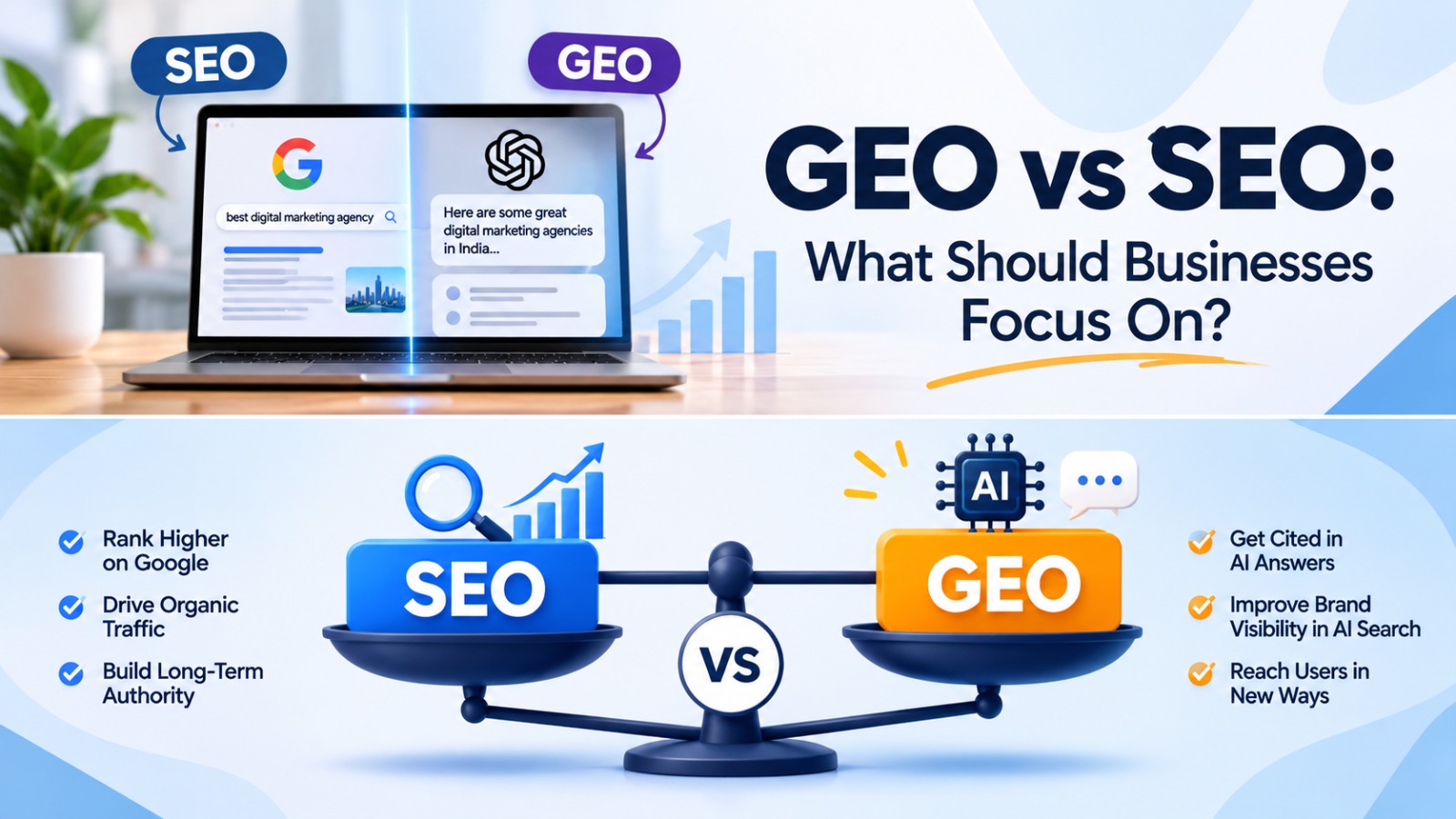
GEO vs SEO: What Should Businesses Focus On?
Search has changed. A few years ago, getting your business found online mostly meant ranking on Google’s first page. Today, your customers also ask ChatGPT, Gemini, Perplexity, and Google’s AI Overviews for recommendations, and they often get a direct answer without clicking a single link.
This has led to a new term that every business owner is hearing: GEO, or Generative Engine Optimization. So how does it differ from SEO, and do you need to choose one over the other? In this guide, we break down GEO vs SEO in simple language and tell you exactly where to put your time and budget.
KEY TAKEAWAY
You don’t have to choose between GEO and SEO. SEO builds the foundation that gets you found, and GEO makes sure AI tools understand, trust, and quote your brand. The smartest strategy in 2026 is to do SEO first and layer GEO on top.
What Is SEO?
Search Engine Optimization (SEO) is the practice of improving your website so that it ranks higher on search engines like Google and Bing. When someone searches for “best digital marketing agency in Mumbai”, SEO is what helps your page appear in those results.
SEO typically covers:
- Keyword research: finding the words your customers actually search for.
- On-page SEO: optimising titles, headings, content, and images.
- Technical SEO: site speed, mobile-friendliness, and crawlability.
- Off-page SEO: earning backlinks and mentions from trusted websites.
- Local SEO: managing your Google Business Profile and local listings.
The goal of SEO is simple: rank higher and earn clicks from people who are ready to learn, compare, or buy.
What Is GEO (Generative Engine Optimization)?
Generative Engine Optimization (GEO) is the practice of making your content easy for AI-powered search tools to find, understand, and use when they generate answers. These tools include ChatGPT search, Google AI Overviews, Gemini, Perplexity, and Microsoft Copilot.
Instead of showing a list of ten blue links, these tools read multiple sources, combine the information, and write one answer. Sometimes they cite the sources they used. GEO is about becoming one of those sources.
IN SIMPLE WORDS
SEO helps you get ranked. GEO helps you get quoted, cited, and recommended by AI.
How AI Tools Choose Which Sources to Use
While every AI platform works differently, content that gets cited usually has these qualities:
- It answers questions clearly and directly, often in the first few lines.
- It comes from a brand or author that shows real expertise and trust.
- It is well-structured, with clear headings, lists, tables, and FAQs.
- It uses structured data (schema) so machines can understand it.
- The brand is mentioned and discussed across the web, not just on its own site.
- It is fresh, accurate, and regularly updated.
GEO vs SEO: Key Differences
Here is a side-by-side comparison to make the difference clear:
| Factor | SEO | GEO |
|---|---|---|
| Main goal | Rank high in search results | Get cited or mentioned in AI-generated answers |
| Where it works | Google, Bing, other search engines | ChatGPT, Gemini, Perplexity, AI Overviews, Copilot |
| What is optimised | Pages and keywords | Answers, entities, and brand authority |
| Content style | Keyword-focused, long-form, in-depth | Clear, direct, quotable, well-structured |
| Key signals | Backlinks, relevance, technical health | Trust, expertise, brand mentions, structured data |
| Success metrics | Rankings, traffic, clicks, conversions | Citations, brand mentions, AI referral visits |
| Time to results | Usually 3 to 6 months or more | Varies; builds along with SEO and brand authority |
QUICK ANSWER
SEO is about being found in search results. GEO is about being chosen as the answer. Both depend on high-quality, trustworthy content.
Where SEO and GEO Overlap
The good news is that GEO is not a replacement for SEO. In fact, they share a lot of common ground:
- Both reward helpful, original, people-first content.
- Both depend on E-E-A-T (Experience, Expertise, Authoritativeness, and Trustworthiness).
- Both need a technically healthy, fast, mobile-friendly website.
- Both benefit from strong backlinks and brand reputation.
Many AI tools also rely on search results to find sources. If your site isn’t visible in search, it is less likely to show up in AI answers either. That is why strong SEO is the base of good GEO.
What Should Businesses Focus On?
The honest answer: both, but in the right order and proportion. Here is a practical way to decide based on your business type.
1. Local Businesses
Clinics, salons, restaurants, and coaching centres should focus about 70% on SEO and 30% on GEO. Local SEO and your Google Business Profile still drive most calls and walk-ins. Add GEO by publishing clear FAQs, service pages, and reviews that AI tools can quote.
2. E-commerce and D2C Brands
Split your effort roughly 60% SEO and 40% GEO. Product page SEO and category optimisation bring sales, while detailed product information, comparison content, and customer reviews help AI shopping answers recommend you.
3. B2B and Service Businesses
Agencies, SaaS companies, and consultants should aim for an even 50/50 split. Buyers here research heavily using AI tools. Thought leadership, case studies, and expert content build the authority that both Google and AI platforms look for.
4. New Startups
Start with SEO fundamentals: a fast website, clear pages, and a handful of helpful blogs. Then build GEO signals early by creating a strong brand presence, structured data, and consistent mentions across trusted platforms.
REMEMBER
These percentages are a starting guide, not a rule. Review your analytics regularly and adjust based on where your customers are coming from.
How to Optimise for Both SEO and GEO: An 8-Step Checklist
- Answer questions upfront. Put a clear, short answer right below each heading, then explain in detail.
- Build topical authority. Cover your subject in depth with connected blogs, not just one-off posts.
- Add structured data. Use FAQ, Article, Organization, and Local Business schema where relevant.
- Show real expertise. Add author bios, case studies, original insights, and genuine experience.
- Use clear formatting. Short paragraphs, bullet lists, tables, and FAQ sections are easier for AI to read and quote.
- Earn brand mentions and backlinks. Get featured on industry sites, directories, podcasts, and trusted publications.
- Keep content fresh. Update old blogs with new information, and show the updated date.
- Track the right metrics. Along with rankings, check referral traffic from AI tools and test whether AI platforms mention your brand for your key questions.
Common Mistakes to Avoid
- Abandoning SEO for GEO. Search is still the biggest source of discoverable traffic for most businesses.
- Publishing AI-written content without expert review. Generic, unoriginal content is unlikely to earn trust from search engines or AI tools.
- Keyword stuffing. Both Google and AI tools prefer natural, helpful writing.
- Ignoring technical basics. A slow or poorly structured site hurts both SEO and GEO.
- Expecting overnight results. Authority and trust take time to build.
Conclusion
The GEO vs SEO debate isn’t about picking a winner. SEO helps people find your website, and GEO helps AI tools recommend your brand. Businesses that treat them as one connected strategy will be visible wherever their customers search, whether that is Google, ChatGPT, or the next AI platform.
FINAL TAKEAWAY
Build your SEO foundation first, then strengthen it with GEO: clear answers, structured content, real expertise, and strong brand authority.
If you’re unsure where to begin, start by auditing your current website, fixing technical issues, and turning your most important pages into clear, helpful, question-answering content.
Frequently Asked Questions
What is the difference between GEO and SEO?
Is GEO replacing SEO?
Should small businesses invest in GEO?
How do I get my brand mentioned in ChatGPT or Google AI Overviews?
Does structured data (schema) help with GEO?
How long does it take to see results from GEO?
How can I measure GEO performance?
Can an agency handle both SEO and GEO for my business?
Ready to Get Found on Google and AI Search?
Brand Fuel helps businesses grow with SEO, GEO-ready content, and complete digital marketing strategies. Let’s build a plan that works for your business.